Metal Gates in Minneapolis, MN
Ornamental ironwork, security gates, alley and driveway gates and repairs for Minneapolis properties, specified to the city's own fence height and permit rules.
St. Paul Elite Metal Gates is your local resource for metal gates, driveway gates, automatic gate operators and ornamental ironwork throughout Minneapolis and Hennepin County. We work with experienced gate fabricators and installers who build for a climate that swings 120 degrees between July and January.
Minneapolis is the one city on this list where the code shapes the gate before the site does. The zoning ordinance caps a fence in a required front yard at three feet, and allows a fourth foot only if it is built of open, decorative, ornamental material less than 60 percent opaque. Nothing anywhere may exceed eight feet, a fence within five feet of a public street or sidewalk is limited to six, and anything over seven feet needs a building permit.
Read that carefully and it says something useful: in a Minneapolis front yard, an ornamental iron gate is legally taller than a solid one. The rule is written to reward openwork, which is why so much of the good gate work in this city is picket and scroll rather than panel. That constraint comes first, and the design follows it.

Custom Metal Gates in Minneapolis, MN
Each service below has its own page with the full specification detail. These are the ones that come up most often on Minneapolis properties, residential and commercial.
Custom Metal Gates
Built to the measured opening in steel, aluminum or true wrought iron, with the material and coating specified before the drawing.
Custom Metal Gates in MinneapolisDriveway Gates
Single and double leaves sized to the clear opening and the grade across it. Slide versus swing gets decided on site, not by preference.
Driveway Gates in MinneapolisAutomatic & Electric Gates
Operators matched to leaf weight and real cycle counts, with remotes, keypads, exit detection and battery backup.
Automatic & Electric Gates in MinneapolisWrought Iron Gates
Ornamental iron and forged detail, including an honest answer about which metal you are actually buying.
Wrought Iron Gates in MinneapolisSliding Gates
V-track and cantilever slide gates for driveways with no room to swing. Cantilever carries the leaf with no ground track to ice up.
Sliding Gates in MinneapolisSwing Gates
Manual or automatic, braced against the sag that takes down every long leaf built without a latch-side diagonal.
Swing Gates in MinneapolisPedestrian Gates
Front entry, side yard and garden walk gates, hung with the clearance to still swing over packed snow in February.
Pedestrian Gates in MinneapolisSecurity Gates
Specified against how gates actually get defeated: reach-through to the latch, climbing, and lifting the leaf off its hinges.
Security Gates in MinneapolisMetal Gate Repair
Sagging leaves, gates off track, seized rollers, bent frames and latches that will not catch. Diagnosis before parts.
Metal Gate Repair in MinneapolisGate Opener Installation
Slide and swing operators installed, wired and commissioned — including the power route, usually the biggest number on the quote.
Gate Opener Installation in MinneapolisGate Opener & Motor Repair
Most dead openers turn out to be a drifted limit, a blocked photo eye or a gate that simply got harder to move.
Gate Opener & Motor Repair in MinneapolisAccess Control Systems
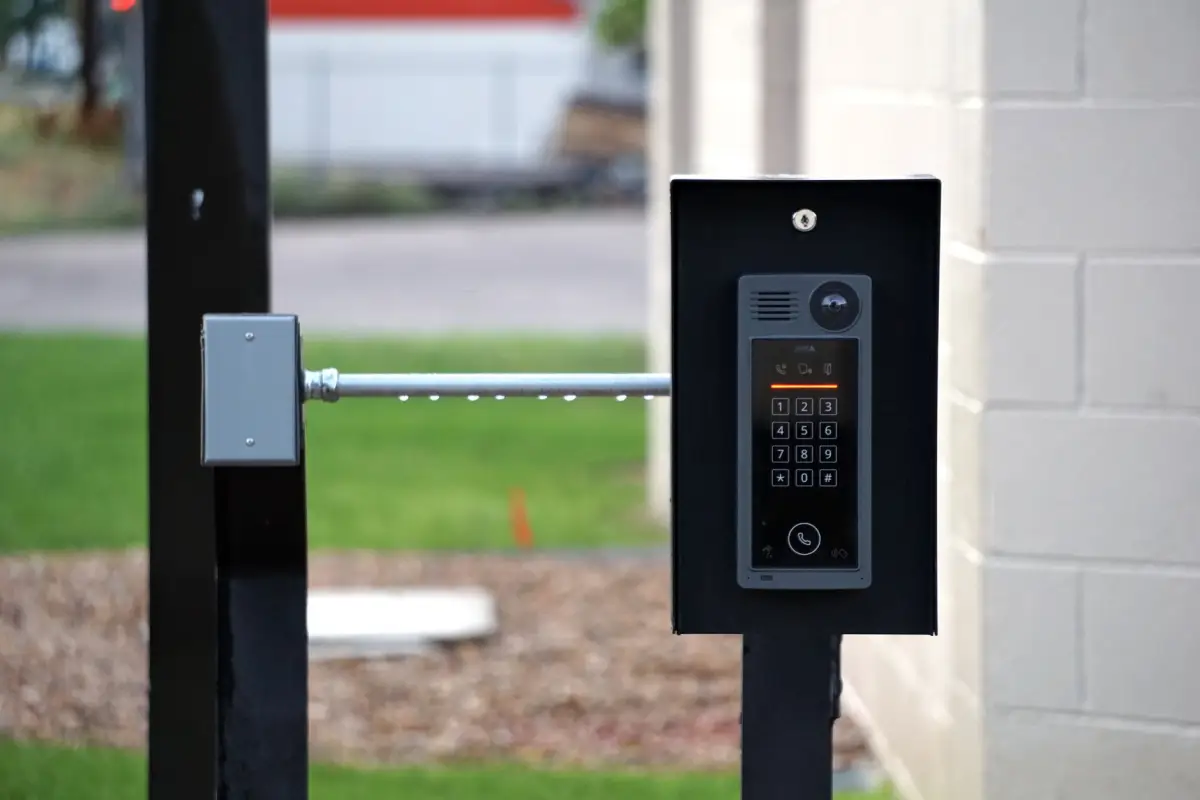
Keypads, fobs, intercom and smartphone entry, built around how you revoke one person's access rather than how the pedestal looks.
Access Control Systems in MinneapolisCommercial Metal Gates
Entrance, yard and perimeter gates specified against cycle count rather than size, with approach setback so trucks are not left in traffic.
Commercial Metal Gates in MinneapolisCommercial Automatic Gates
High-cycle operators, vehicle detection and UL 325 safety systems sized on the peak hour, not the daily average.
Commercial Automatic Gates in MinneapolisCommercial Security Gates
Parking, warehouse and perimeter gates with credentials that can be revoked one person at a time. The perimeter gets walked first.
Commercial Security Gates in MinneapolisCommercial Gate Repair
Automatic gate, motor, track and hardware repair plus preventative maintenance tied to your real cycle count.
Commercial Gate Repair in MinneapolisIndustrial & Heavy-Duty Gates
Heavy slide and steel security gates engineered for truck loads and shift-change throughput, with a wear-item list at handover.
Industrial & Heavy-Duty Gates in Minneapolis
Residential Metal Gates in Minneapolis, MN
Most residential gate work here is alley and side-yard work rather than front-drive work. The city's grid puts garages on the alley, which means the vehicle gate is at the back of the lot, opening onto a shared right of way with no arc to spare and a plow that treats the alley last. A swing leaf into an alley is generally the wrong answer; a slide gate on a cleared back-run, or a cantilever gate where there is no back-run, is the configuration that works.
The front of the property is a different job governed by the height rule. A three-foot solid fence and gate, or four feet of open ornamental work, is what the required front yard allows — so the gate there is doing definition and controlled access rather than security. Where security is the actual goal, it is worth saying so early, because a four-foot front gate does not provide it and no amount of hardware changes that.

Commercial Metal Gates in Minneapolis, MN
Commercial gate work in Minneapolis is dominated by two things: constrained sites and constant cycling. Loading courts, parking structures, contractor yards and enclosure areas all sit in tight footprints where a swing arc simply does not exist, and where the gate is being asked to open and close dozens of times a day.
That combination points hard at cantilever slide gates with commercial-rated hardware and an operator class sized on the peak hour rather than the daily average — peak is the window operators actually fail in. Access control matters as much as the gate: on a property with staff, tenants, contractors and deliveries, the question is not whether the gate opens on a credential but how fast one specific credential stops working. And where the gate opens onto a public sidewalk or street, the UL 325 entrapment-protection devices are not a formality, because the people crossing that closing edge are not employees who have been briefed.

Driveway Gates in Minneapolis, MN
Where a Minneapolis property does have a street-facing drive, it is usually short, close to the sidewalk and directly in the salt zone. Interstate 35W and the arterial grid around it are salted through the winter, and plow spray reaches a gate that sits ten feet off the curb far more effectively than one set eighty feet back.
So the coating gets specified against that exposure. A duplex system — hot-dip galvanized first, then powder coated — is the honest answer for a gate with no setback, at 1.5 to 2.3 times the combined service life of the two coatings applied separately, per the American Galvanizers Association. The other city-specific detail is the sidewalk. A gate cannot swing out over a public walk, which on a short drive with no depth behind the opening leaves a slide or cantilever gate as the only workable configuration, whatever the design brief said.
Automatic Gate Installation in Minneapolis, MN
Automating an alley gate is a different job from automating a suburban driveway gate. The run is short, but the environment is harsher: a shared alley surface delivers grit, gravel and frozen slush into anything at ground level, which is why a V-track slide gate is a poor choice here and a cantilever gate is usually the right one. Power is often close, since the garage is right there, and that is one of the few things about a city site that is easier.
The safety requirements are stricter in practice because of who is nearby. ANSI/CAN/UL 325 requires two independent entrapment-protection devices at every entrapment zone, and the operator's inherent reversing system counts as only one, so photo eyes and edge sensors go in at the closing edge and at the hinge pinch point and get proven by physically blocking the gate. In an alley where pedestrians, cyclists and other residents pass within feet of a moving leaf, that testing is the entire point of the standard.
Custom & Ornamental Metal Gates
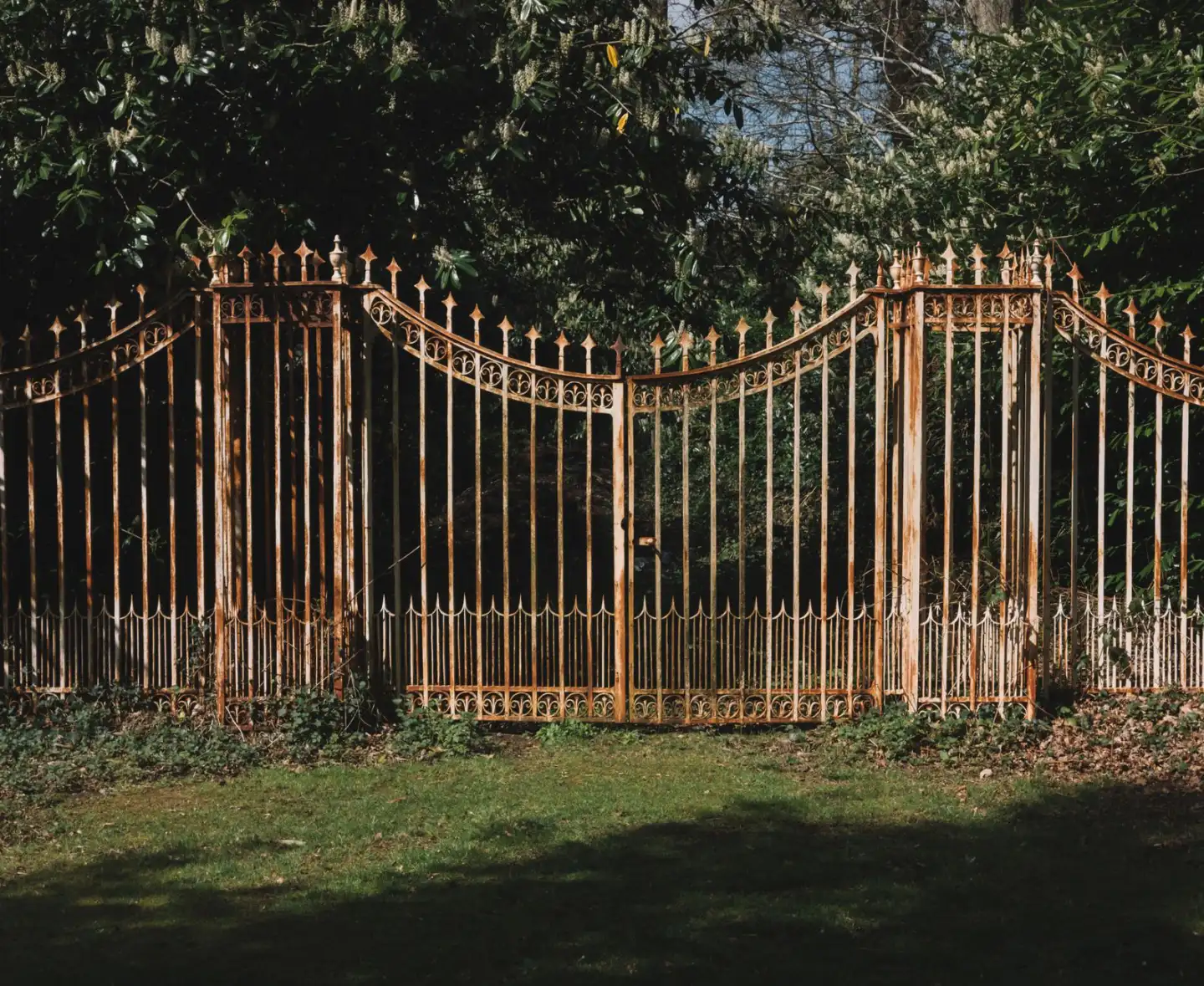
Minneapolis has the deepest stock of genuinely old ironwork in this service area, and the districts to prove it. The Washburn-Fair Oaks Mansion District, in the Whittier neighborhood around Washburn-Fair Oaks Park, was added to the National Register on 17 February 1978 and takes in seven mansions along and near East 22nd Street, several of them Georgian Revival houses designed by William Channing Whitney. The Healy Block Residential Historic District — fourteen Queen Anne houses, most built by Theron P. Healy — was listed on 27 May 1993. The Milwaukee Avenue Historic District carries its own design guidelines.
On or near property of that period, matching is the discipline: picket spacing, top-rail profile, finial pattern and joint style, not an approximation of them. It is also where true wrought iron earns its price rather than being a marketing word — forged scrollwork, hammered collars and mortise-and-collar joints instead of plain welds, with a lead time to match because the work happens at a forge. Everywhere else in the city, mild steel is the right material and should be priced as mild steel, which is what almost all so-called wrought iron in this metro actually is.

Metal Gate Repair in Minneapolis, MN
City ironwork fails in a particular order, and it starts at the ground. The bottom rail and the base of each post sit in salted slush all winter, and the question that decides the repair is surface rust versus section loss. Surface rust comes off with a wire wheel and takes a zinc-rich primer and topcoat. Section loss means the steel has measurably thinned in a structural member, and coating over that is decoration on a failing part — the member comes out.
Posts are the second question. Hennepin County is frost Zone II under Minnesota Rules 1303.1600 at a 42-inch minimum, and ironwork set decades ago to whatever depth was convenient has been lifting a little every spring since. On a boulevard fence line where the post is in a narrow strip between sidewalk and street, that movement is compounded by everything else happening in that strip. A gate whose latch has been relocated more than once is not describing a latch problem.
Specified for a 42-Inch Frost Line and 365,000 Tons of Road Salt
A phone number and a truck in the driveway don't make a company. Here's what's actually different about how a gate gets specified for a job in Minneapolis, MN.
Footings Below the Frost Line
Minnesota Rules 1303.1600 puts Ramsey, Hennepin, Washington, Dakota and Anoka Counties in frost Zone II: 42 inches minimum. A post stopped short of that because the ground was frozen and nobody wanted to keep digging is a post that lifts, and a lifted post is a new gate rather than an adjustment.
Coating Specified Before Color
365,000 tons of road salt go down in the Twin Cities metro every year, and plow spray finds the bottom rail first. Hot-dip galvanized, or galvanized then powder coated, gets chosen against that exposure — the color chart comes after.
Safety Devices Tested by Obstruction
UL 325 and ASTM F2200 exist because automated gates injure people. Photo eyes and edge sensors get proven by physically blocking the gate at the closing edge and at the hinge pinch point before handover, not ticked off a list with the sensors still in the box.

Around Minneapolis, MN
Washburn-Fair Oaks Mansion District
Listed on the National Register in 1978 and centered on Washburn-Fair Oaks Park in Whittier — the highest concentration of period ironwork context in the service area, and the toughest matching work.
Healy Block
Fourteen Queen Anne houses, most built by Theron P. Healy, listed in 1993. The kind of block where a new gate has to disappear into what is already there rather than sit beside it.
The alley grid
Most Minneapolis garages open onto an alley rather than a street, which is why the majority of vehicle gates in the city are rear-lot gates with no swing arc and a shared surface underfoot.
When This Isn’t the Right Call
- If your opening is under about eight feet, a single stock swing leaf will usually do the job for a fraction of a custom build. Measure the clear opening in Minneapolis before you spend anything.
- If you want a wood gate, this is the wrong page. A cedar gate hung on steel hinge posts is a legitimate answer and a different trade.
- If it is one sagging hinge on a four-foot walk gate, 8.4 miles each way is a poor trade for you and for whoever drives it. Call somebody on your own block and keep this page for the driveway.
- If the budget stops at a chain-link rolling gate, buy the chain-link rolling gate. It is an honest piece of hardware, and a custom gate value-engineered down to nothing satisfies nobody.
- If the existing gate sags but the frame and posts are still sound, a repair is almost always the cheaper and better answer than a replacement. Ask for that answer before you ask for a quote on a new gate.
Frequently Asked Questions
- Do you serve Minneapolis, MN?
- Yes. Minneapolis is 8.4 miles west-northwest of St. Paul. Hennepin County is inside the service area along with Ramsey, Washington, Dakota and Anoka.
- How tall can a gate be in a Minneapolis front yard?
- Three feet, or four if it is built of open, decorative, ornamental material that is less than 60 percent opaque — that extra foot is written into the city's zoning code specifically for openwork. A fence not in a required yard but within five feet of a public street or sidewalk is capped at six feet, and nothing anywhere may exceed eight. Anything over seven feet needs a building permit, along with a zoning check, a plan review and an inspection. Pool barrier fences need a permit at any height.
- Do I need a permit for a standard residential gate in Minneapolis?
- Generally not for a standard residential fence and gate under seven feet, but the height and location rules still apply whether or not a permit does. Over seven feet, a building permit, zoning check, construction plan review and city inspection are all required. Pool barriers require a permit at any height, with a site plan showing found property monuments or a survey.
- What kind of gate works in a Minneapolis alley?
- A cantilever slide gate, most of the time. There is no arc for a swing leaf in a shared alley, and a V-track slide gate depends on a ground track staying clear — which an alley surface, with its grit, gravel and frozen slush, does not allow. A cantilever gate carries the leaf on its posts with nothing on the ground. It needs back-run space beside the opening, which is the one thing worth measuring before anything else.
- How deep do gate posts have to go in Minneapolis?
- 42 inches. Minnesota Rules 1303.1600 places Hennepin County in frost Zone II, at a 3-1/2 foot minimum footing depth for frost protection. On a boulevard or a narrow strip between sidewalk and street there is a second question underneath it — what utilities are in that strip — which gets located before any auger goes in the ground.
Learn More
- Minnesota Rules 1303.1600 — Footing Depth for Frost Protection — the state rule placing Ramsey, Hennepin, Washington, Dakota and Anoka Counties in Zone II at a 42-inch minimum footing depth
- American Galvanizers Association — Duplex Systems — the technical basis for the 1.5 to 2.3 times service-life figure for powder coat over hot-dip galvanizing
- Minnesota Pollution Control Agency — Chloride and Winter Salt — the agency's own accounting of how much road salt goes down across the Twin Cities metro each winter, and where it ends up
Need a Metal Gate in Minneapolis, MN?
Tell us what’s going on and get an immediate on-site quote — no charge for the estimate, and no obligation to book it.
Get My Free Estimate