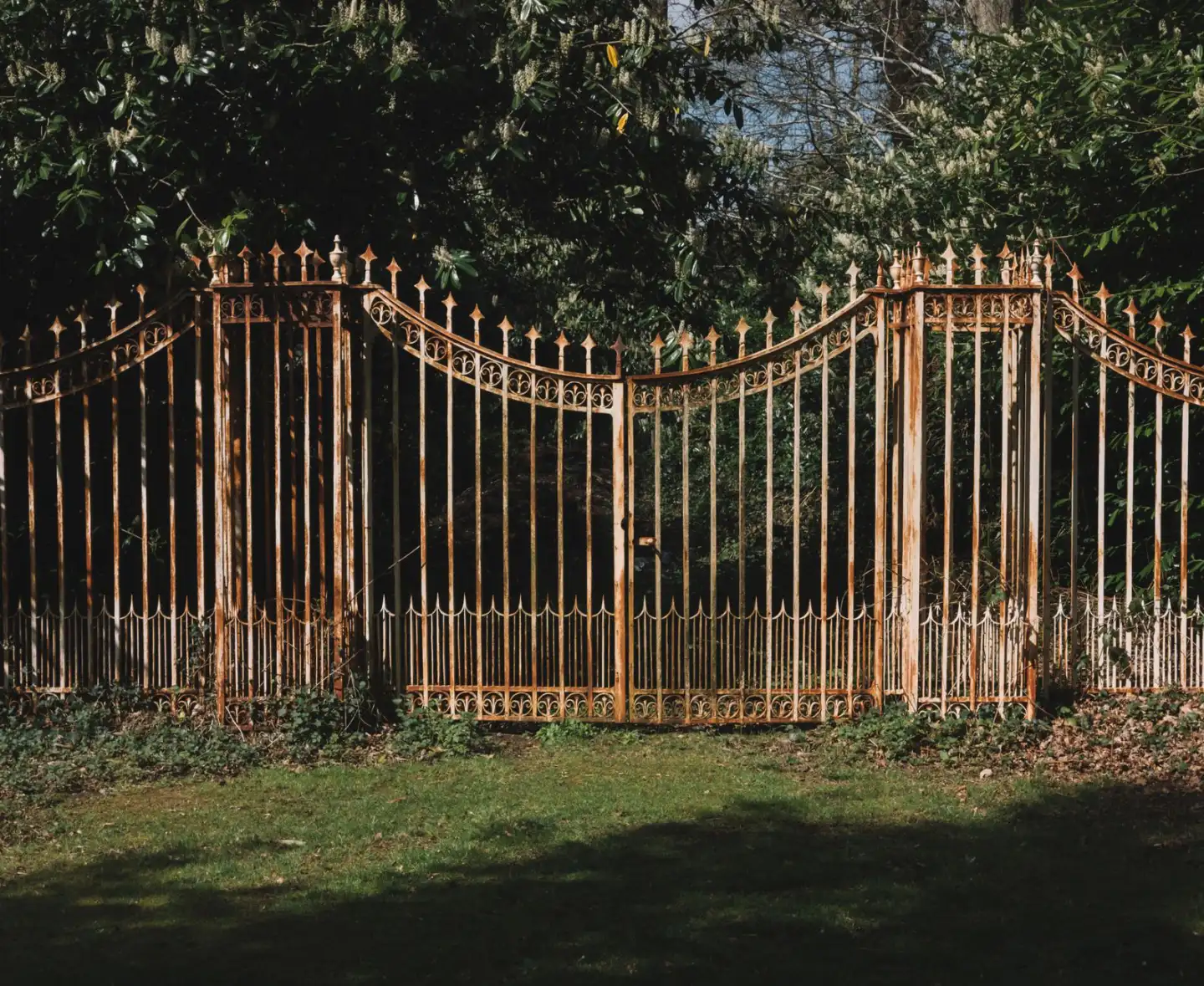
Metal Gate Repair in St. Paul, MN — Residential & Commercial Gate Repairs
Most gate problems are one of four things: the post moved, the leaf dropped, a roller failed, or the hardware is out of alignment. Diagnosis first, parts second.
Metal Gate Repair in St. Paul, MN
St. Paul Elite Metal Gates is your local resource for metal gate repair, gate opener service, driveway gates and ornamental iron fencing throughout St. Paul and Ramsey, Hennepin, Washington, Dakota and Anoka Counties. We work with experienced local gate installers who diagnose the cause before they quote the part.
A gate that has stopped working properly is almost never mysterious. Four causes account for most of it: a hinge or latch post that has moved, a leaf that has deflected at its free end, a roller or carriage that has failed, or hardware that is simply out of alignment. Which one it is determines whether the fix is an afternoon or a re-dig, and the diagnosis is the part worth paying attention to.
The seasonal pattern here is its own diagnostic. Problems that appear in January are usually ice — a V-track packed with frozen slush, a drop-rod sleeve full of it, a latch that has iced shut. Problems that appear in April are usually frost heave, because the ground moved over the winter and put the gate somewhere it was not. Problems that appear gradually over years are metal fatigue and coating failure. A gate that scrapes the driveway isn't settling in. The post is.
What’s Included in a St. Paul Metal Gate Repair Quote
- On-site diagnosis: post plumb, leaf deflection, hinge condition, roller and track condition, hardware alignment
- A stated cause before a quoted part — 'the hinge post has heaved four inches out of plumb' rather than 'the gate needs work'
- Realignment, re-hanging and hardware adjustment where the structure is sound
- Welded repairs to bent, cracked or racked frames, with added bracing where the original had none
- Hinge, roller, carriage, latch and drop-rod replacement with hardware rated for the finished leaf weight
- Track cleaning, resetting or replacement on V-track slide gates, and carriage service on cantilever gates
- Coating repair at cut and weld locations so the repair does not become next year's corrosion site
- An honest call on repair versus replacement, including when the post footing is the real problem
Metal Gate Repair in St. Paul, MN
Sliding Gate Repair
The most common call is that the sliding gate came off track. Almost always the cause is a worn, cracked or seized roller: when one wheel stops rolling the gate drags, lifts on that side and jumps the V. Debris does the same — gravel, wet leaves in autumn, and in this metro, packed slush that freezes solid in the track and simply will not let the gate move. A gate that worked fine in October and quit in January did not break; it found the ice. Other symptoms in this family: the sliding gate is dragging on the apron, it needs a shove to get started, it makes a grinding noise partway along its run, or it stops short and won't fully open or close. On a cantilever gate the equivalent failures are worn roller carriages and a bent or sagging counterbalance tail. Repair means diagnosing which of those it is before replacing anything, because a new roller on a bent track fails again in a season.
Swing Gate Repair
Swing gates fail in two ways and the symptoms are easy to tell apart. If the driveway gate is sagging and the latch no longer meets the keeper but the hinge post is still plumb, the leaf itself has deflected — the frame has racked from a parallelogram into something that droops at the free end, and the repair is to square it, weld in a latch-side diagonal brace and re-hang it. If the hinge post has visibly tilted or lifted relative to the fence beside it, the footing has heaved and no amount of hardware adjustment will hold. Related symptoms: the gate won't close all the way, the gate won't latch without a lift, the bottom rail has drawn an arc into the asphalt, or a double gate's leaves no longer meet in the middle. Hinges that have worn oval, pulled out of the post, or seized entirely are the third cause and the simplest to put right.
Gate Hinge, Roller & Track Repair
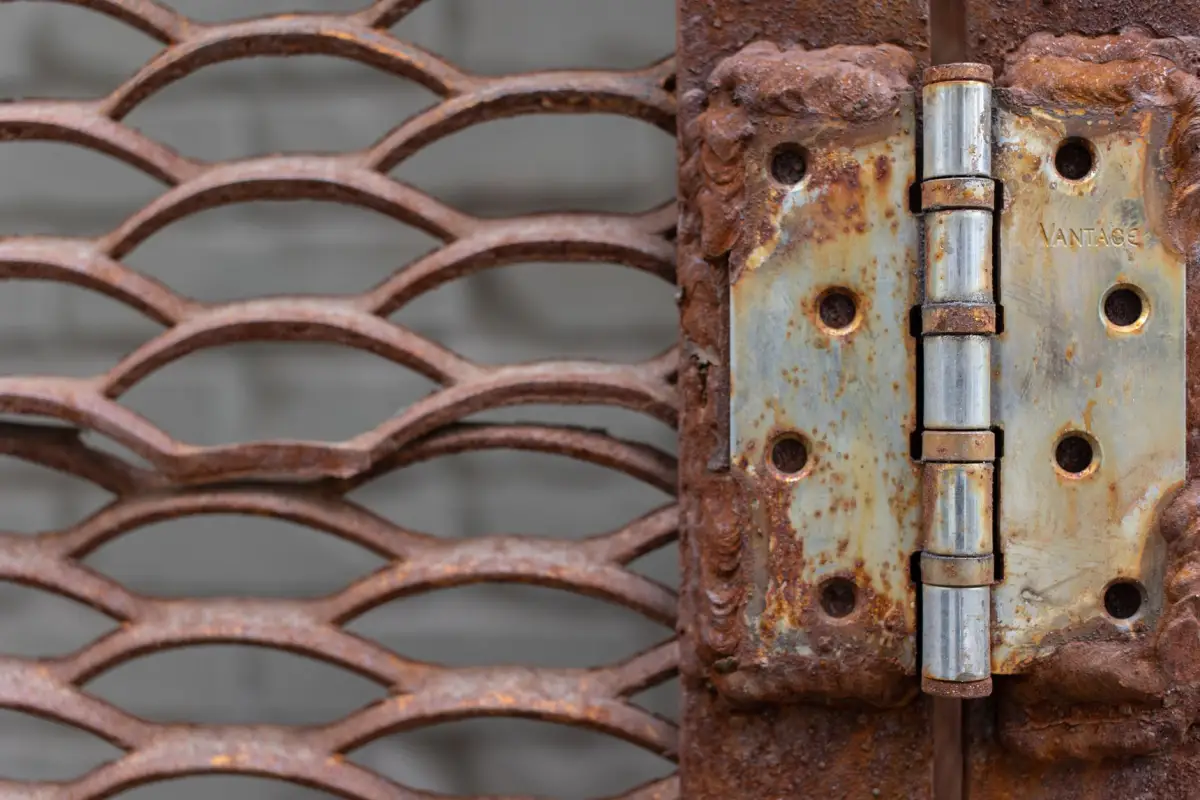
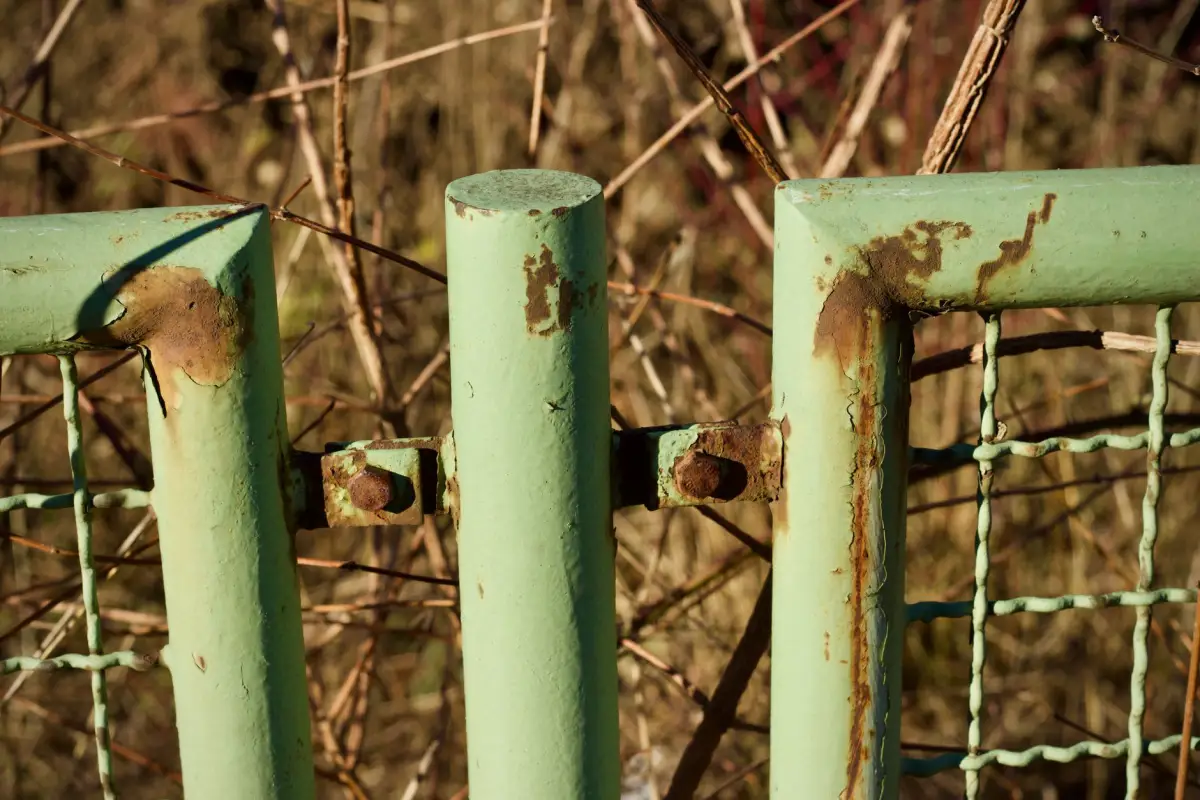
Hardware wears in a predictable order and the noises tell you where you are in it. A hinge that has begun to wear will creak and then develop play you can feel by lifting the leaf at its free end — an eighth of an inch of lift at the hinge is a lot of movement at the latch. Left alone, the pin ovals the barrel and the gate starts to drop. On slide gates, roller bearings dry out, then get noisy, then seize; a seized roller is the moment the gate starts dragging and the operator starts working harder. Track wears too: the V flattens, gets peened over at the ends, or lifts where the apron has heaved beneath it. Replacement hardware gets specified against the finished leaf weight rather than matched to whatever was there, because undersized hardware is often why the original failed early.
Bent & Damaged Metal Gate Repair
Gates get backed into. It happens on narrow drives, in alleys, and to any gate that opens toward the street, and the damage is usually a bent bottom rail, a bowed picket run or a leaf pushed out of square. Steel is repairable — bent sections can be straightened or cut out and replaced, and a racked frame can be pulled square and re-braced so it stays there. Aluminum is less forgiving: it dents rather than springing back and it work-hardens, so a section that has been straightened once will not take it twice. Two things separate a repair that lasts from one that does not. The first is squaring the frame properly rather than forcing the latch to meet the keeper. The second is coating every cut, weld and ground-back area afterward, because bare steel at a weld is where corrosion starts, and an uncoated repair in this metro's road salt is a repair with a scheduled expiry.
Gate Alignment, Latch & Hardware Repair
A large share of gate complaints are alignment rather than damage. The gate won't latch, the two leaves of a double gate no longer meet, the drop rod won't drop into its sleeve, the automatic gate stops an inch short of closed. In spring these are often the same problem: the frost lifted something an inch and put every piece of hardware out of register. In winter they are usually ice — a drop-rod hole full of frozen slush, a keeper pocket packed with it, a gravity latch that froze shut overnight. The right sequence is to establish whether the geometry moved or the hardware failed before adjusting anything, because moving a keeper to meet a gate that has dropped hides the cause and the gate keeps dropping. Where the geometry is sound, re-setting keepers, stops and drop-rod sockets to the gate's settled resting position is quick work with a lasting result.
Signs You Need Metal Gate Repair
- The gate won't latch without being lifted, or won't close all the way
- A sliding gate has come off its track, drags, or needs a shove to start moving
- The bottom rail has worn a visible arc into the driveway surface
- The hinge post leans or has lifted relative to the fence beside it
- Hinges creak, have play when you lift the leaf, or have pulled at their fixings
- The gate was backed into and the frame is bent or out of square
- The drop rod won't drop, or the two leaves of a double gate no longer meet
- An automatic gate stops short of closed, or reverses partway through its travel
How Metal Gate Repair Works

- 1
Diagnose the cause before quoting the part
The visit starts with four checks in a fixed order. Post plumb, taken with a level on both hinge and latch posts, and compared against the fence line beside them — a post that has lifted relative to its neighbours has heaved, which is a footing problem and not a hardware one. Leaf deflection, checked by measuring the gap at the top and bottom of the latch stile; a wedge-shaped gap means the frame has racked. Hinge play, felt by lifting the free end of the leaf and watching the hinge barrels. And on a slide gate, every roller is turned by hand and the track is sighted end to end for flattening, lifting or debris. Only after those four is anything quoted, because the same symptom — a gate that will not latch — comes from all four causes and each has a different fix at a different price.
- 2
Correct the geometry first
Hardware is adjusted to the gate, never the other way around. If the leaf has racked, it gets pulled square and a latch-side diagonal brace gets welded in, which is usually the piece the original build omitted. If the hinge post has heaved, the repair is at the footing: excavate, reset the post to the 42-inch Zone II depth Minnesota Rules 1303.1600 requires, and re-collar it — shimming a heaved post buys one season. If the track on a slide gate has lifted or flattened, it is reset or replaced and the apron beneath it is corrected to drain. Moving a keeper an inch to meet a gate that has dropped is the repair people ask for and the one that guarantees a return visit, because the gate that dropped an inch this year will drop again next year.
- 3
Replace worn hardware to the right rating
Once the geometry is right, worn parts come out. Hinges, rollers, carriages, latches and drop rods are specified against the finished leaf weight and the gate's actual cycle count rather than matched to what was there, because undersized hardware is frequently the reason the original failed early — a heavy ornamental leaf on hinges chosen for a picket gate will chew through them repeatedly. On slide gates, rollers are replaced in sets rather than singly, since a new roller running against three worn ones takes the whole load and fails next. Bearings are checked for grease serviceability, because sealed units that cannot be greased have a fixed life in a climate with this much moisture cycling through freeze and thaw. Everything gets run through full travel afterward to confirm the gate moves freely along its whole path, not just at the ends.
- 4
Re-coat every cut, weld and ground area
This is the step that separates a repair that lasts from one that becomes next spring's corrosion. Every weld, every ground-back area and every drilled hole exposes bare steel, and bare steel at the bottom of a driveway gate is in the worst place it could be — the MPCA estimates roughly 365,000 tons of road salt goes down in the Twin Cities metro each year, and the plow spray zone is the bottom eighteen inches of the gate. Repairs get cleaned back to sound metal, primed with a zinc-rich primer and top-coated to match. Where the original gate was hot-dip galvanized, cold galvanizing compound goes on the repair before the topcoat. It is a small amount of work and it is the difference between a weld that lasts twenty years and one that is weeping rust by the following autumn.
What Does Metal Gate Repair Cost in St. Paul, MN?
- Which of the four causes it is — hardware, alignment, leaf deflection or a heaved footing, in ascending order of cost
- Whether the post has to be excavated and reset, which is the single largest variable on a gate repair
- Number and type of hardware items being replaced, and whether they are stock or have to be matched to an older gate
- Whether the frame needs squaring, cutting and re-welding, and whether bracing has to be added that was never there
- Slide gate track condition: cleaned, reset, or replaced along with correcting the apron beneath it
- Access and season — a frozen ground repair in January is a different job from the same repair in June
- Coating repair extent, and whether the original finish is powder coat, paint or galvanizing
- Whether an operator is involved, which moves part of the work onto the gate opener repair side
The honest range on gate repair is wide because the same symptom spans a tenfold cost difference. A gate that will not latch might need a keeper moved, or it might need a hinge post dug out and reset below frost. That is why the diagnosis comes first and free, and why a phone quote for a gate repair is a number somebody made up. If a heaved footing turns out to be the cause, replacing the gate rarely helps — the new gate goes on the same post.
What to Look for in a St. Paul Gate Repair Company
They name the cause, not just the fix
'The hinge post has lifted two inches' is a diagnosis. 'The gate needs work' is a quote about to become an argument.
The frame gets squared before hardware moves
Relocating a keeper to meet a dropped gate hides the problem. Ask whether the leaf is being squared or the hardware is being chased.
Bracing gets added where it was missing
Most sagging gates never had a latch-side diagonal. Repairing without adding one repairs the symptom and reschedules the failure.
Rollers get replaced in sets
One new roller against three worn ones carries the load alone and fails next. A repair that replaces a single roller is a repair you will pay for twice.
Welds get re-coated
Bare steel at a weld in the salt spray zone is a scheduled failure. Coating repair should be part of the quote, not an extra.
They will tell you when to replace instead
A badly corroded frame with section loss is not economically repairable. Being told that is more useful than being sold a repair that lasts a season.
Residential & Commercial Metal Gate Repair
Residential
Repairs to driveway, walk and garden gates across St. Paul, Highland Park, Merriam Park, Maplewood, Roseville and the eastern suburbs — including the spring wave of frost-heave problems that arrive every April.
Commercial
Repairs to yard, lot and entrance gates on commercial sites, where the cycle counts that caused the wear also dictate the hardware rating on the way back in. Commercial gate repair is covered in more depth on its own page.
When Metal Gate Repair Isn’t the Right Call
- If the frame has genuine section loss — corrosion that has eaten through the tube rather than sitting on the surface — repair is throwing money at it. Replacement is the honest answer.
- If the problem is the motor, the control board or the sensors rather than the gate itself, the gate opener repair page is the right place to start.
- If the gate is wood on steel posts, the metalwork may be repairable but the gate is a different trade.
- If the gate is fundamentally the wrong type for the driveway — a V-track slide gate on an apron that ices over every winter — repeated repairs are not the answer to a configuration problem.
- If the property is outside Ramsey, Hennepin, Washington, Dakota or Anoka Counties, look for someone closer.
Frequently Asked Questions
- Why won't my gate close all the way?
- Four possibilities, in the order worth checking. The leaf has dropped at its free end, so the latch stile is now low and hits the keeper. The hinge post has heaved and changed the gate's whole geometry. A slide gate has debris or ice in its track. Or, on an automated gate, a travel limit has drifted and the operator is stopping where it thinks closed is. The gap shape tells you a lot: a wedge-shaped gap means the leaf has racked, a parallel gap means something moved bodily.
- My sliding gate came off its track. What caused it?
- Nearly always a roller. When one wheel cracks, seizes or wears flat, that corner drags and lifts, and the gate walks out of the V. Debris in the track does the same thing — gravel, packed leaves, or frozen slush. Less often, the apron beneath the track has heaved and lifted a section of track out of line. Replacing a single roller on a gate whose others are worn just moves the failure to the next one, so rollers get changed in sets.
- Why is my driveway gate sagging?
- Either the frame has racked or the hinge post has moved, and the way to tell is to check the post with a level. Plumb post plus a dropped latch end means the leaf is deflecting, which almost always means it was built without a latch-side diagonal brace. A tilted or lifted post means the footing has heaved, which usually means it was set shallower than the 42-inch Zone II minimum. The second one is the expensive answer and the first one is the common one.
- My automatic gate is stuck open. What should I check first?
- Power, obstruction, then sensors. Confirm the operator has power and the battery backup has not simply run down. Look for a physical obstruction in the track or the arc — in winter, ice is the usual answer. Then check the photo eyes for misalignment, dirt, snow or spider webs, since a blocked eye will hold the gate open by design. If none of that explains it, the fault is likely in the operator, which is the gate opener repair side of the work.
- Is it cheaper to repair a gate or replace it?
- Repair, in most cases, because the expensive parts of a gate installation are the posts and the footings and a repair usually reuses them. The exception is corrosion with real section loss — where the tube wall has been eaten through rather than just rusted on the surface — since welding to compromised metal is patching rather than repairing. If the hinge post footing is the problem, note that replacing the gate does not fix it; the new gate goes on the same post.
- Why do gate problems always appear in spring?
- Because that is when the frost lets go. A post set above the 42-inch frost depth lifts through the winter and settles back imperfectly, which moves the gate's geometry an inch or so and puts every latch, keeper and drop-rod socket out of register at once. The gate closed fine in November and won't latch in April, and nothing visible happened in between. That pattern is close to diagnostic on its own.
Learn More
- Minnesota Rules 1303.1600 — Footing Depth for Frost Protection — the 42-inch Zone II minimum behind most of the frost-heave failures that show up as spring gate repairs
- Minnesota Pollution Control Agency — Chloride — the road-salt volumes that make coating repair at every weld and cut a necessary part of the job here
- DASMA — An Installer's Guide to ASTM F2200 — roller retention, gap and guarding requirements that a repair on an automated vehicular gate has to preserve
Need Metal Gate Repair in St. Paul, MN?
Tell us what’s going on and get an on-site estimate — no charge for the visit, and no obligation to book the work.
Get My Free Estimate