Commercial Security Gate Installation in St. Paul, MN — Business & Facility Perimeters
A perimeter is only as strong as the point nobody looked at. The gate matters; so do the fence run beside it, the lighting, and where the trucks park.
Commercial Security Gates in St. Paul, MN
St. Paul Elite Metal Gates is your local resource for commercial security gates, perimeter fencing, automated access systems and commercial gate repair throughout St. Paul and Ramsey, Hennepin, Washington, Dakota and Anoka Counties. We work with experienced fabricators and installers who specify the perimeter, not just the opening.
Commercial security is a perimeter problem with a gate in it. The gate gets the attention because it is the visible part, but a well-built gate in a fence line that can be climbed forty feet away is a gate people walk around. The first job on any commercial security project is to walk the whole boundary and find the point that actually decides how secure the site is.
The second job is deciding what the gate is defending against, because the answers are different. Casual entry and trespass is a fence-and-lighting problem. Theft of vehicles, equipment or material from a yard is an access-control and detection problem. Vehicle intrusion is a structural problem that turns posts into bollards. Specifying against all three at once is how commercial security budgets get spent on the wrong things.
What’s Included in a St. Paul Commercial Security Gates Quote
- Full perimeter walk to identify the actual weak point before any gate is specified
- Threat definition — trespass, theft, vehicle intrusion — since each drives a different specification
- Gate infill, spacing and top profile chosen against climbing, reach-through and cutting
- Frame in closed section, non-removable hinge pins or welded stops, and shrouded or interior-only latching
- Post and footing design for lateral force where vehicle resistance is required, on top of the 42-inch Zone II frost minimum
- Access control with individually revocable credentials and an entry log where the site needs one
- Coordination with lighting, camera positions and any existing site security system
- Free-egress provision so a secured perimeter never conflicts with a required exit route

Commercial Security Gate Installation in St. Paul, MN
Business & Facility Security Gates
On an office, clinic or light-industrial facility the security gate is usually managing a mixed population — staff who need routine access, visitors who need controlled access, deliveries at set times, and contractors on temporary permissions. That mix argues for credentials that can be issued and revoked individually rather than a shared code, and for an entry log where anything of value or sensitivity is on site. Physically, the gate has to look like part of the building rather than like a compound, which usually means picket or slat infill with tight spacing rather than a solid panel. Setback matters here too: a visitor stopped at a gate needs somewhere to wait that is not a traffic lane, and an intercom position that a driver can reach without opening a door in February. Egress is the constraint that overrides everything — a secured perimeter can never impede a required exit route.
Parking Lot Security Gates
Parking control has a different objective from perimeter security: it is usually about keeping unauthorised vehicles out and managing throughput rather than resisting a determined intrusion. That makes barrier arms and lighter vehicle gates entirely appropriate, since a barrier arm stops the casual entry and controls the count without pretending to be a wall. The design questions are throughput and queuing — where the detection loops sit, how long the auto-close timer runs, and whether a vehicle waiting to enter blocks the street. Tailgating is the characteristic failure, and the answer is loop placement and timing rather than closing faster. Where the lot also needs after-hours perimeter security, the usual arrangement is a barrier arm for daytime throughput and a proper security gate closing the same opening at night.
Warehouse & Industrial Security Gates
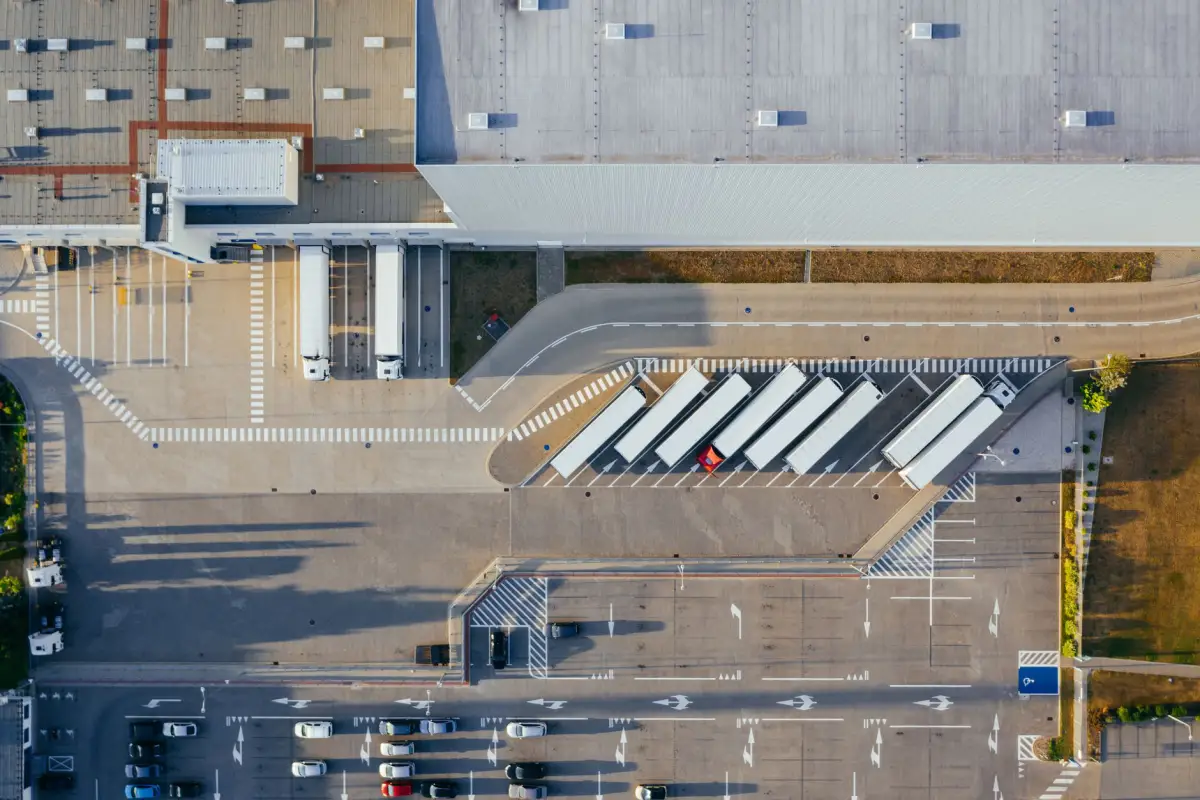
A warehouse or yard gate has to pass tractor-trailers, which sets opening width and approach geometry before anything else, and it usually has to do so many times a day, which sets the hardware ratings. Security here is largely about the yard: trailers, equipment, material and fuel are what gets taken, and they leave through the gate on wheels. That makes vehicle detection, credentialing and a log more valuable per dollar than a heavier leaf. The physical specification still matters — closed frame sections, tight infill, hinge pins that cannot be driven out, and posts sized for impact where a vehicle could be driven at the gate. The perimeter beside it matters as much: a fence line a trailer can be backed through is the actual weak point, and no gate specification addresses it.
Controlled-Access Commercial Gates
Controlled access means the gate knows who is coming through and can be told to stop letting them. On a commercial site that generally requires a controller with a credential database rather than a reader that accepts anything programmed to it, so a departing employee's fob is deleted in seconds without re-issuing everyone else's. Fobs and cards work through gloves, which matters here. Long-range readers pick up a windshield tag as a vehicle approaches, removing the stop entirely. Where visitors are frequent, a video intercom at the gate lets someone see who is asking before the gate moves. Entry logging turns a security incident from a guess into a record. The systems themselves — readers, controllers, intercoms and vehicle detection — are covered in more depth on the gate access control page.
Commercial Perimeter Security Gates
The perimeter gate is the one that closes a fence line rather than an entrance, and its specification is governed by what the fence beside it does. A gate stronger than its fence is money spent on the wrong object; a gate weaker than its fence is the obvious way in. That means matching height, infill density and top treatment across both, and it means walking the whole line for the things that undo it — a stacked pallet against the fence, a dumpster enclosure that works as a step, a section where the ground falls away and the effective height drops to four feet, a neighbouring property that offers a route in. Lighting and camera coverage do a great deal of the work at the perimeter, and the cheapest time to run that conduit is while the gate's power conduit is already open.
Signs You Need Commercial Security Gates
- Equipment, material or vehicles have gone missing from the yard
- The site is accessible after hours and nothing physically stops entry
- Access is controlled by a code that has not changed since people who have left still knew it
- There is no record of who entered the site or when
- A fence line has an obvious weak point — a low section, a stack of pallets, an unsecured neighbouring route
- Insurance, a client or a contract requires controlled and documented site access
- The existing gate can be lifted off its hinges, reached through, or pushed open
How Commercial Security Gates Works
- 1
Walk the perimeter and define the threat
Nothing gets specified before the boundary is walked in full, because the gate is rarely the weakest point and specifying it first is how commercial security money gets misspent. The walk records where the fence drops in effective height, where stored material or equipment functions as a step, where a neighbouring property offers a route in, and where sightlines and lighting fail. In parallel the threat gets defined honestly: casual trespass, theft of specific assets, or vehicle intrusion. Those need different answers — trespass is largely fence, lighting and sightlines; theft is access control, detection and logging; vehicle intrusion is structural, and it turns posts into bollards with footings to match. The output is a prioritised list, and frequently the gate is not item one on it.
- 2
Specify the gate against how gates get defeated
Each defeat method has a specific counter and they are worth naming individually. Climbing is answered by top profile and by removing outside-face horizontal rails that act as steps. Reach-through to the latch is answered by infill spacing and by moving the latch inboard or behind a shroud. Lifting the leaf off is answered by non-removable hinge pins or a welded stop on the top hinge. Prying and cutting are answered by closed frame sections and by infill that cannot be spread. Pushing is answered by a positive lock or a heavy drop rod into a sleeved socket rather than a gravity latch. Vehicle intrusion is answered by post section and footing mass, not by the leaf. The specification is then checked back against the fence beside it, so the two match rather than one embarrassing the other.
- 3
Set posts for force, locate services, and pour
Footings start at the 42-inch Zone II minimum set by Minnesota Rules 1303.1600 and go up from there — diameter and reinforcement are governed by leaf weight, wind load on the infill and any vehicle impact requirement, and on a security gate those usually govern well before frost does. Commercial sites have buried services nearly everywhere, so locates are done rather than assumed, and post positions are checked against easements, fire lanes and the property line. Posts are set to a string line, plumbed and braced while the concrete cures, and the receiving side gets the same treatment as the hinge side, since a latch post that can be pushed aside makes a strong leaf irrelevant. Where the gate is automated, conduit for power, detection loops, lighting and cameras all goes in during the same excavation.
- 4
Commission access control, lighting and egress
The access system is configured with individually revocable credentials and, where the site needs it, entry logging — and the handover includes the site's own staff adding and deleting a user, because a system nobody can administer becomes a shared code within a year. Safety devices are commissioned to ANSI/CAN/UL 325 with two independent entrapment-protection devices at each entrapment zone, tested by physically obstructing the gate. Then egress: a secured perimeter must never impede a required exit route, so free-egress hardware, a marked pedestrian gate or a documented release is verified rather than assumed. Lighting and camera positions are confirmed while the conduit is still open. The default installer codes are changed, which on commercial sites is routinely left undone.
What Do Commercial Security Gates Cost in St. Paul, MN?
- Perimeter length and condition, since fence remediation is frequently the higher-value spend
- Opening width, vehicle type and whether vehicle impact resistance is required
- Infill density, top treatment and frame section — closed tube and tight spacing cost more than picket and channel
- Security hardware: shrouded latching, positive locks, non-removable hinge pins, heavy drop rods and sleeved sockets
- Post size, footing diameter and reinforcement where lateral force governs the design
- Access control scope: credential type, controller with a database, entry logging and vehicle detection
- Lighting and camera coverage, and the conduit they need while the ground is open
- Utility locates, easements and any hand digging that commercial site conditions force
The most common way commercial security money gets wasted is spending it all on the entrance. Before pricing the gate, price the walk-around: if there is a section of fence a person can step over or a trailer can be backed through, that section is the project and the gate is phase two. Any contractor who quotes the gate without walking the boundary is quoting the visible part of the problem.
What to Look for in a St. Paul Commercial Security Gate Contractor
They walk the whole boundary
A gate quoted without the perimeter walk is a gate quoted in isolation from the thing it is meant to secure.
The threat is defined before the product
Trespass, theft and vehicle intrusion need different answers. A specification that does not distinguish them is a general-purpose guess.
Egress is verified, not assumed
A secured perimeter can never impede a required exit. That gets checked and documented, not left to the datasheet.
Credentials can be revoked individually
If removing one person's access means changing everyone's, it will not get done. Ask how revocation actually works.
Locates happen before digging
Commercial sites are full of buried services. Locates are the difference between a schedule and an incident report.
They will point at the fence instead of the gate
When the boundary is the weak point, hearing that from someone who sells gates is the strongest signal you will get.
When Commercial Security Gates Isn’t the Right Call
- If the fence line can be stepped over or driven through, the gate is not the project. Fix the perimeter first or the gate buys nothing.
- If the requirement is throughput control rather than intrusion resistance, a barrier arm does that job at a fraction of the cost.
- If the gate would sit in or across a required egress route or a fire lane, the code governs and that conversation starts with the city.
- If nobody on site will administer credentials, a simpler system with multiple independent codes will serve better than one that needs managing.
- If the site is outside Ramsey, Hennepin, Washington, Dakota or Anoka Counties, find a contractor closer — security hardware needs responsive service.
Frequently Asked Questions
- Where should we spend first on commercial site security?
- Usually not on the gate. Walk the boundary and find the point that actually decides how secure the site is — a low fence section, stored material acting as a step, an unsecured neighbouring route, a dark corner with no camera coverage. Fixing that is often cheaper than the gate and does more. The gate matters once the boundary around it is credible.
- Will a commercial security gate stop a vehicle?
- Only if it was designed to. Vehicle resistance is a structural property of the posts and footings, not of the leaf — an impressive-looking gate on ordinary fence posts will bend and swing open. Where vehicle intrusion is a real threat, posts are designed closer to bollards with footing mass and reinforcement to match, and that is a materially different specification and cost.
- Should a commercial security gate be solid or open infill?
- Open infill in most cases. A solid panel hides whoever is behind it from cameras and staff, blocks a driver's view of pedestrians, and acts as a sail that drives up post, footing and operator sizing. Tight picket or slat spacing stops reach-through and climbing while keeping the approach visible and overlooked, which is usually worth more than the privacy.
- How do we handle access for contractors and temporary staff?
- With credentials that can be issued and revoked individually — per-user codes with expiry dates, fobs registered to a controller, or app-based access with a defined end date. A shared code given to a crew never gets changed after they leave. If the site needs a record of who was on it and when, an entry log matters as much as the credential itself.
- Can a security gate conflict with fire code requirements?
- Yes, which is why egress gets verified rather than assumed. A gate across a fire lane, an access route the fire department needs, or a required exit path has specific requirements, and those govern over any security preference. That conversation starts with the city and the fire marshal before the gate is designed, not after it is installed.
- Do we need cameras as well as a security gate?
- For most commercial sites, yes — a gate controls access while cameras provide the record, and together they are worth considerably more than either alone. The practical point is timing: the cheapest moment to run camera and lighting conduit is while the gate's power conduit is already open, so the positions are worth deciding early even if the equipment comes later.
Learn More
- DASMA — Vehicular Gate Operators and the ANSI/CAN/UL 325 Standard — the entrapment-protection requirements that apply to an automated security gate regardless of its security rating
- Saint Paul DSI — Fence Plan Review, Permit and Inspections — the city's fence permit process, inspection triggers and the requirements that apply to a perimeter enclosure
- Minnesota Rules 1303.1600 — Footing Depth for Frost Protection — the 42-inch Zone II baseline that security-gate footings start from before impact loading is considered
Need Commercial Security Gates in St. Paul, MN?
Tell us what’s going on and get an on-site estimate — no charge for the visit, and no obligation to book the work.
Get My Free Estimate