Pedestrian Gates in St. Paul, MN — Residential & Commercial Walk-Through Gates
Small gates get used ten times more than driveway gates and get half the engineering. Hinge, latch and post are what decide whether it still shuts in February.
Pedestrian Gates in St. Paul, MN
St. Paul Elite Metal Gates is your local resource for pedestrian gates, driveway gates, ornamental iron fencing and gate access control throughout St. Paul and Ramsey, Hennepin, Washington, Dakota and Anoka Counties. We work with experienced gate fabricators and installers who build for a climate that swings 120 degrees between July and January.
A pedestrian gate is the most-used piece of metal on a property. A driveway gate might cycle four times a day; a side yard gate gets pushed, kicked, leaned on and slammed by everyone who walks through it, including delivery drivers who have never seen it before. It is also the gate most often built from whatever was left over, which is why the walk gate is usually the first thing on a fence line to fail.
The engineering is small but not trivial. St. Paul requires gates in a fence line to be self-closing, self-latching and lockable, which puts real weight on hinge and latch selection — and cold-weather behaviour is part of that. A self-closing hinge tuned on a mild afternoon behaves differently at ten below, and a gravity latch that collects meltwater will freeze shut by morning. Posts still need footings below the 42-inch Zone II frost depth, because a small gate on a heaved post binds exactly the same way a large one does.
What’s Included in a St. Paul Pedestrian Gates Quote
- Opening measurement at the finished post faces, plus the swing path and the surface the gate travels over
- Frame specification appropriate to the traffic — a public-facing entry gate is not a garden gate with a different latch
- Hinge selection for weight, frequency and cold performance, including self-closing hinges where the code requires them
- Latch selection that stays workable in winter, with lockable hardware where St. Paul's fence rules apply
- Post sizing and footings below the 42-inch Zone II frost depth at both hinge and latch posts
- Coating specified for a gate whose bottom rail sits at sidewalk salt level
- Threshold and clearance detail so the gate still swings over an inch of packed snow
- Access hardware where it applies: keyed entry, keypad, electric strike or a maglock with a documented release


Pedestrian Gate Installation in St. Paul, MN
Front Entry Pedestrian Gates
The gate at the front walk is the one visitors touch and the one that sets what the property looks like from the sidewalk. On Summit Avenue, Grand Avenue and through Crocus Hill that usually means matching existing ironwork — picket spacing, top rail profile, finial style and pier detail all taken from what is already there rather than from a catalog. It is also the gate with the highest cycle count on most properties, so hinges are chosen for frequency rather than for looks, and the latch has to work with one hand while the other holds groceries. Clearance over the walk matters more here than anywhere else: a gate hung tight to a paver path will bind on the first inch of packed snow, and the fix in February is a shovel rather than a service call only if the gate was hung with that inch in mind.
Side Yard & Walkway Gates
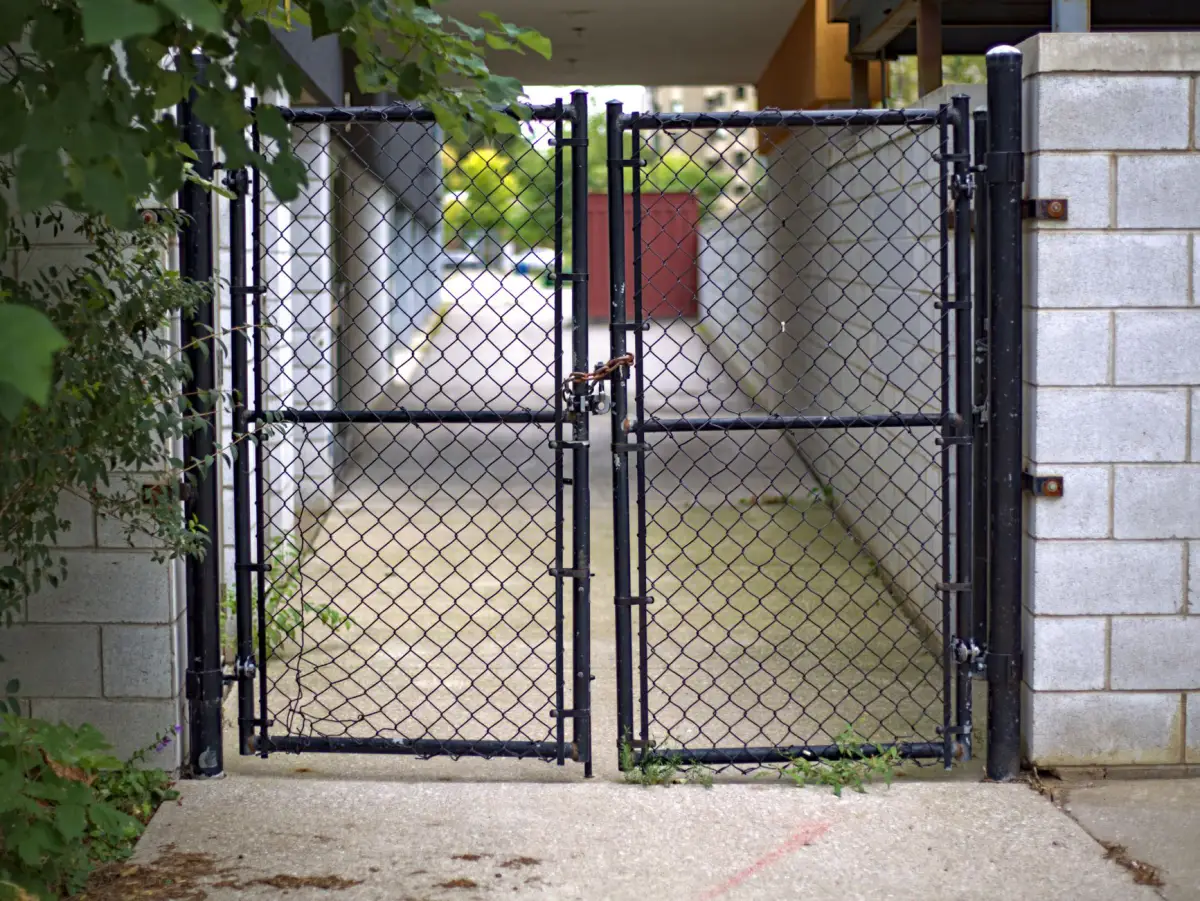
The side yard gate takes the most abuse and gets the least attention. It is the gate contractors carry material through, the gate that gets propped open with a brick and then slammed, and the gate that lives in the narrow gap between two houses where the ground is never quite level and the snow never quite melts. Older St. Paul neighborhoods — Payne-Phalen, Dayton's Bluff, Merriam Park — are full of them, usually between a house and a garage with an alley behind. Practical requirements: a frame stiff enough to survive being leaned on, hinges rated well above the leaf weight because they will be shock-loaded, a latch that can be operated from both sides, and enough ground clearance for the drifted snow that collects in a gap between two buildings. Where the gap is truly narrow, a gate that opens flat against the fence beats one that swings into the walk.
Garden & Courtyard Gates
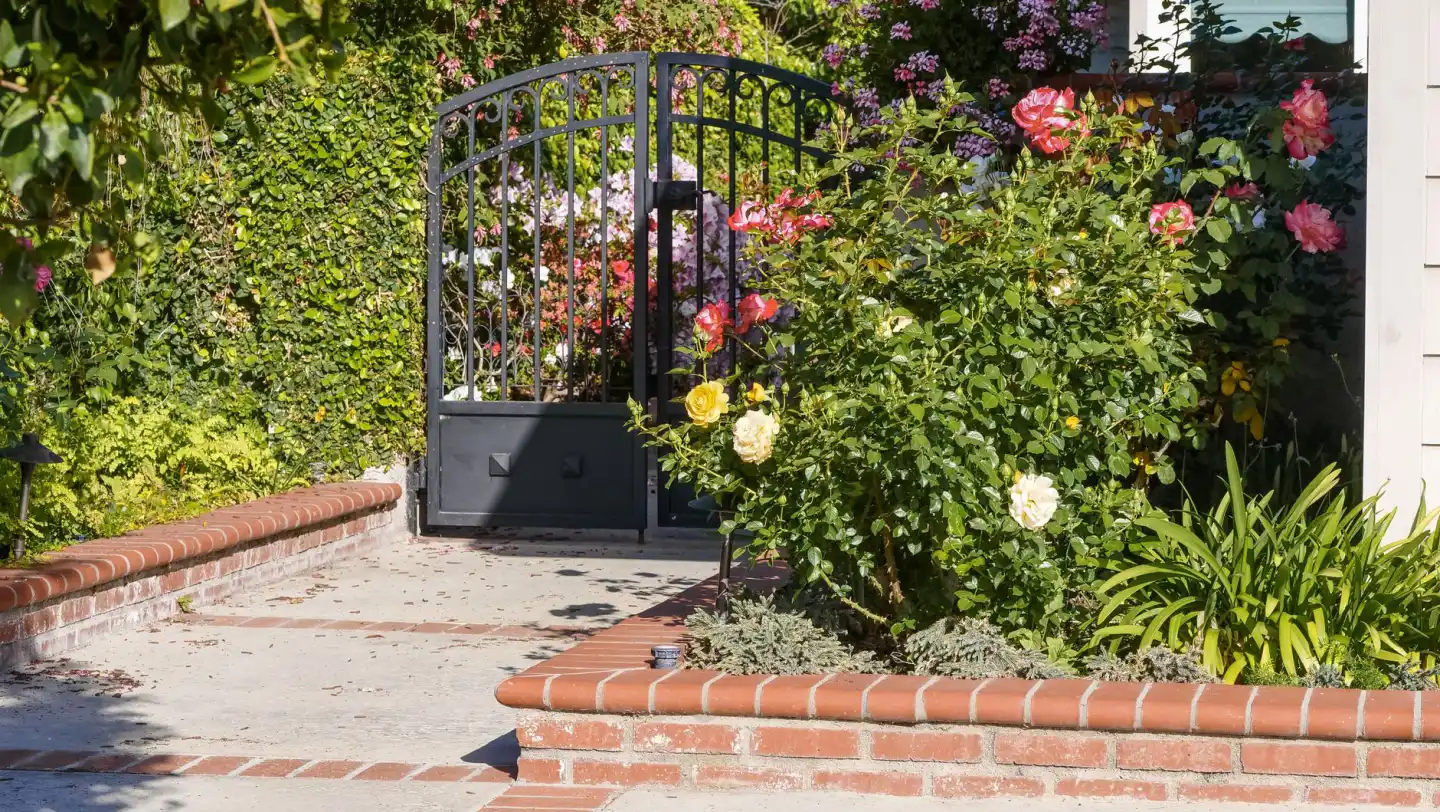
A garden gate is the one place where the ornamental work can lead, because the structural demands are modest and the gate is seen close up. Forged scroll panels, cast rosettes, ring-and-collar detail and arched top rails all read properly at four feet away in a way they do not at the end of a driveway. Two climate notes that get overlooked. First, a flat top rail on a garden gate collects snow and holds it against the joints, so a peaked or rolled top sheds better on a north-facing courtyard entrance. Second, planting matters: a gate set into a hedge or a vine-covered wall will be pushed on by growth over time, and clearance that was fine when the gate went in disappears in about four seasons. Leaving swing clearance and specifying a coating that will survive being in contact with wet foliage is part of the job.
Security Pedestrian Gates
Where the walk gate is doing real security work rather than marking a boundary, the specification changes. Picket spacing tightens so nothing reaches through to the latch, the top gets a profile that is unpleasant to climb rather than a convenient handhold, and the latch moves inside a shroud or behind a solid panel. Hinges get non-removable pins or welded stops so the gate cannot be lifted off. The frame gets closed sections instead of open channel. Where the gate is part of a controlled entry — an apartment building, a shared courtyard, a business rear entrance — the hardware moves to an electric strike or a maglock with a documented fail-safe release, which is a life-safety requirement rather than a preference. The entry devices themselves, from keypads to card readers and video intercom, are covered on the gate access control page.
Custom Metal Walk-Through Gates
Most walk gate openings are odd, because they were left over after the fence line was laid out or they sit between two structures that were never square to each other. A custom walk gate gets built to the measured opening, with the hinge stile shaped to a pier that is out of plumb rather than shimmed to fake it. Custom also covers the awkward cases: a gate in a masonry wall with no post to hang from, a gate that has to clear a step, a gate matched to an original from a house that is a century old. And it covers weight, which is the number people get wrong on small gates — a solid ornamental walk gate can weigh more than a picket driveway leaf twice its size, and that is a hinge and post decision, not a detail.
Signs You Need Pedestrian Gates
- The gate no longer latches without being lifted, which means the leaf has dropped or the post has moved
- It binds on the walk after the first snowfall and stays that way until spring
- The latch freezes shut, or ices up and has to be worked loose by hand
- Hinges are rusted, loose in the post, or the screws have pulled
- The gate does not close on its own and city fence rules require it to be self-closing and self-latching
- The gate has been kicked, leaned on or backed into and the frame is visibly out of square
How Pedestrian Gates Works

- 1
Measure the opening and the surface under it
Two measurements and one observation. The clear opening is taken at the finished post faces. The swing path is checked against the walk, any step or threshold, planting and where snow accumulates — the gap between a house and a garage drifts differently from an open front walk, and a gate hung with a half-inch of ground clearance in July is a gate that will not open in January. The observation is what the gate is hanging from. A wood fence post, a masonry pier, a house wall and a freestanding steel post are four different mounting conditions with four different hinge answers, and a century-old pier on a Crocus Hill property will be out of plumb by an inch or more over its height. That gets designed around in the hinge stile rather than corrected with shims, which is the difference between a gate that closes for twenty years and one that needs adjusting every spring.
- 2
Specify frame, hinges and latch for the real traffic
Traffic decides the hardware, and it is routinely underestimated on walk gates. A front entry gate on a busy household can cycle dozens of times a day, and a side yard gate gets shock-loaded by people carrying things through it. Hinges are therefore rated well above the leaf's static weight, and where St. Paul's fence rules require self-closing and self-latching operation, the closer has to be selected to still close the gate at ten below rather than just on the afternoon it was set. Latch choice follows the same logic: gravity latches collect meltwater and freeze, so a shielded or sprung latch is the better answer on an exposed gate. Frame section follows the leaf weight, and solid ornamental infill weighs far more than picket infill of the same size — a fact that sinks more small gates than any other single thing.
- 3
Set posts to frost depth and hang with winter clearance
Small gates get shallow footings more often than large ones, on the reasoning that the gate is light. Frost does not care about the gate's weight — Minnesota Rules 1303.1600 sets a 42-inch minimum for Zone II, which covers Ramsey, Hennepin, Washington, Dakota and Anoka Counties, and a walk gate post at 24 inches will heave and bind exactly the way a driveway post does. Both hinge and latch posts get the same treatment, since a latch post that moves throws the keeper out of alignment just as effectively. The gate is then hung with deliberate ground clearance — enough to swing over an inch of packed snow rather than the minimum gap that looks tidiest in summer. Where the gate crosses a step or a slope, the bottom rail is cut on a rake to keep clearance consistent through the arc rather than only at the closed position.
- 4
Set the latch, then test it closed and cold
Latch hardware is located after the gate has been hung and allowed to settle onto its hinges, not while it is on sawhorses. The keeper is set to the gate's resting position, and the closer is adjusted so the gate latches under its own power without slamming — a self-closing gate that has to be helped is not compliant, and one that slams will destroy its own latch within a season. Where the gate is part of a controlled entry, the electric strike or maglock is wired and the release is tested, including the fail-safe behaviour on a power loss, which is a life-safety item rather than a convenience. The last check is the one most often skipped: the gate is operated from both sides, one-handed, the way an actual person will use it. A latch that needs two hands and a knee is a latch that will be propped open by March.
What Does a Pedestrian Gate Cost in St. Paul, MN?
- Opening width and gate height, and whether the leaf is picket, slat or solid ornamental infill
- Material — aluminum, steel or forged ironwork — and the ornamental content, which is fabrication hours
- Hinge and latch specification, including self-closing hardware where the fence code requires it
- Mounting condition: freestanding steel posts, an existing masonry pier, or a wall with no post at all
- Footings at both posts to the 42-inch Zone II minimum, and access for digging in a narrow side yard
- Coating specification for a gate at sidewalk level in a metro that salts heavily
- Access hardware: keyed entry, keypad, electric strike or maglock with a code-compliant release
- St. Paul DSI fence permit fees where the gate is part of a fence line
Walk gates are where value engineering does the most damage per dollar saved. Undersized hinges, a shallow footing and a latch that was chosen because it was on the shelf will together save a modest amount on install day and produce a gate that has to be adjusted every spring. The hardware on a gate that gets used twenty times a day is not the place to economize; the ornamental content, which nobody's hands touch, is.
What to Look for in a St. Paul Pedestrian Gate Installer
Hinges are rated above the leaf weight
Walk gates get shock-loaded, not just loaded. Hardware sized to the static weight is hardware sized for the wrong job.
Winter clearance is deliberate
A gate hung with a minimal gap looks tidy in July and binds on packed snow in January. The clearance should be a decision, not a leftover.
The latch works one-handed
If it needs two hands, it will be propped open. Test it the way you will actually use it before the crew leaves.
Footings match the driveway gate's
42 inches applies to a walk gate post as much as to a hinge post carrying a 14-foot leaf. Frost does not scale with the gate.
Self-closing hardware is set for cold
A closer adjusted on a mild day will struggle at ten below. Ask whether it has been set with that in mind.
They flag when a repair beats a replacement
A racked frame can often be squared and re-braced. Being told that instead of being sold a new gate is the signal worth looking for.
Residential & Commercial Pedestrian Gates
Residential
Front entry, side yard, garden and courtyard walk gates for homes across St. Paul, Summit Hill, Highland Park, Como Park, Maplewood and Roseville — hung with the clearance to still swing in February.
Commercial
Walk gates for business entrances, shared courtyards, apartment buildings and service access, specified for public traffic volumes and, where controlled entry applies, with code-compliant electric hardware and documented release.
When Pedestrian Gates Isn’t the Right Call
- If the opening is a driveway rather than a walk, this is the wrong page — the structure, hardware and cost are a different scale entirely.
- If you want a wood garden gate, that is a perfectly good choice and a different trade.
- If the existing gate is only out of square and the posts are sound, squaring and re-bracing it is usually cheaper than replacing it.
- If the gate is part of a pool enclosure, the barrier requirements are stricter than general fence rules and the inspection is separate — start with the city, not with us.
- If the property is outside Ramsey, Hennepin, Washington, Dakota or Anoka Counties, look for someone closer.
Frequently Asked Questions
- Do pedestrian gates need to be self-closing in St. Paul?
- Gates in a fence line within the city are required to be self-closing, self-latching and lockable. That makes the closer and latch a code item rather than a preference, and it makes cold-weather performance part of the specification — a closer set on a mild afternoon may not fully close and latch the gate at ten below unless it was adjusted with that in mind.
- How deep do walk gate posts need to go?
- The same 42 inches a driveway gate post needs. Minnesota Rules 1303.1600 sets footing depth by frost zone, and Ramsey, Hennepin, Washington, Dakota and Anoka Counties are Zone II at a 42-inch minimum. Frost lifts a post regardless of how light the gate hanging on it is, and a heaved walk gate post binds the gate and throws the latch out of alignment just as thoroughly.
- Why does my gate latch freeze shut every winter?
- Usually a gravity latch collecting meltwater that refreezes overnight, or a keeper pocket that holds slush. Shielded or sprung latches shed water better. The other common cause is that the gate has dropped slightly, so the latch bar sits low in the keeper, catches on the edge and holds moisture there. If the latch worked for years and now freezes, look at the gate's alignment before blaming the hardware.
- My gate scrapes the path after it snows. Can that be fixed?
- Yes, and there are two separate fixes depending on the cause. If the gate was hung with minimal ground clearance, it can often be re-hung higher or the bottom rail trimmed. If the gate has dropped at its free end, adding a diagonal brace and re-hanging it addresses the actual problem. If the hinge post has heaved, neither fix lasts — that is a footing repair.
- What is the right width for a pedestrian gate?
- Three to four feet handles almost everything, including someone carrying a bicycle or a laundry basket through it. Narrower than about 32 inches gets awkward with anything in your hands. Wider than four feet and the leaf starts to deflect and the hinges start to work harder for no real gain — at that point the question is whether a second leaf or a wider service gate is what you actually want.
- Can a pedestrian gate be fitted with a keypad or intercom?
- Yes. A walk gate is a very common access-control point, using a keypad, card reader, video intercom or smartphone entry driving an electric strike or a maglock. The one non-negotiable is the release: the hardware has to fail in the direction that lets people out, and the release has to be documented and tested at handover. Entry system options are covered in more detail on the access control page.
Learn More
- Saint Paul DSI — Fence Plan Review, Permit and Inspections — the city's fence and gate requirements, including self-closing and self-latching gates, height limits and permit fees
- Minnesota Rules 1303.1600 — Footing Depth for Frost Protection — the 42-inch Zone II minimum that applies to a walk gate post as much as to a driveway gate post
- American Galvanizers Association — Duplex Systems — why powder coat over hot-dip galvanizing outlasts either coating alone on metal that sits at sidewalk salt level
Need Pedestrian Gates in St. Paul, MN?
Tell us what’s going on and get an on-site estimate — no charge for the visit, and no obligation to book the work.
Get My Free Estimate